How to Plan a Concrete Sidewalk Project in Atlanta
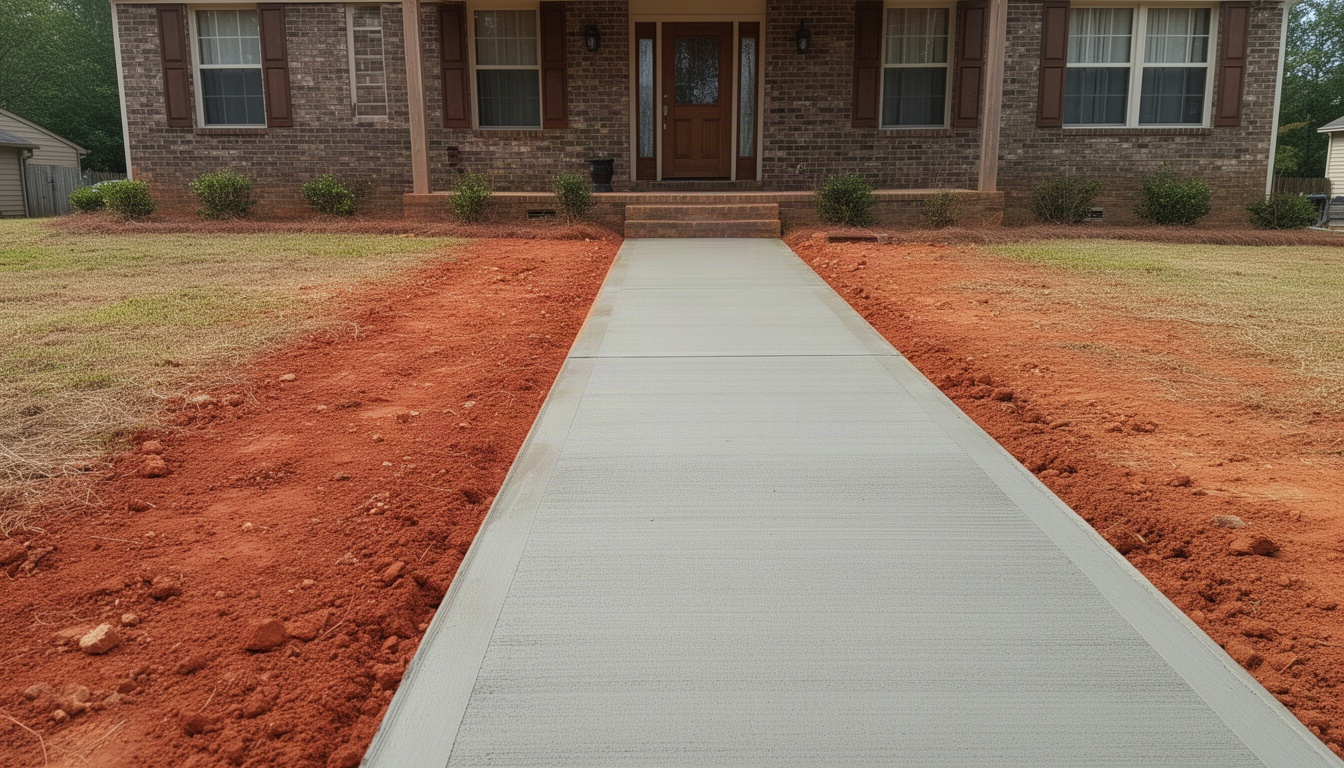
Concrete Sidewalk Installation in Atlanta, GA: Dekalb Concrete serves Atlanta and the surrounding area. Visit dekalbconcretellc.com for a free quote.
TL;DR: Planning a concrete sidewalk in Atlanta requires understanding City of Atlanta right-of-way permits ($75–$150 for residential work), accounting for red clay soil that needs 6–8 inches of excavation depth, budgeting $6–$12 per square foot for standard finishes, and hiring a licensed Georgia contractor. The best pouring window is April–May or September–October when temperatures stay between 50°F and 80°F.
In This Article
- What Does Planning a Concrete Sidewalk in Atlanta Actually Involve?
- Do You Need a Permit for a Sidewalk in Atlanta?
- How Much Does a Concrete Sidewalk Cost in Atlanta?
- How to Prepare the Ground for a Concrete Sidewalk in Atlanta
- Choosing the Right Concrete Mix and Thickness for Atlanta's Climate
- How to Hire a Concrete Sidewalk Contractor in Atlanta
- Frequently Asked Questions
- Getting Your Sidewalk Project Started
What Does Planning a Concrete Sidewalk in Atlanta Actually Involve?
If you're thinking about adding or replacing a concrete sidewalk in Atlanta, the planning phase is where most homeowners get tripped up - especially if you're unfamiliar with how red clay soil behaves or what the City of Atlanta requires. Learn more about preparing ground for concrete in Atlanta.
Planning breaks down into five core steps: understanding permit requirements, assessing soil and site conditions, calculating realistic costs, choosing the right concrete mix, and vetting a qualified contractor. (Atlantaga.gov) (Usda.gov) Atlanta's expansive clay soil, humidity, and occasional freeze-thaw cycles create conditions that differ significantly from national guidelines you'll find online.
Red clay is the big wildcard. Georgia's Cecil and Appling soil series - which dominate Fulton and DeKalb Counties - shrink and swell with moisture changes, cracking concrete that isn't properly supported underneath. That's why preparing the ground is critical before you pour a single yard of concrete.
Do You Need a Permit for a Sidewalk in Atlanta?
Direct answer: Yes. If your sidewalk touches the public right-of-way (the area between the property line and the street), you need a City of Atlanta right-of-way encroachment permit. If it's entirely on private property and not part of a development, the rules vary by county.
Before starting work, check with the City of Atlanta Department of Public Works or your county building department to confirm whether your project requires a permit. Right-of-way permits typically cost $75–$150 for residential work under 500 square feet. You can submit a right-of-way permit application directly through atl311.com.
If you're in unincorporated DeKalb or Fulton County, contact your local county building department to understand the specific permit requirements for your project. Any work touching the public right-of-way typically requires a permit.
Call the City of Atlanta Department of Public Works at (404) 330-6240 or check with your county building department to confirm whether your project needs a permit. If your sidewalk is near a state-numbered route, Georgia DOT may also need to approve setback distances - typically a minimum of two feet from the back of curb where feasible.
Also check the City of Atlanta Tree Ordinance. Trees with trunk diameters of 6 inches or larger are protected, and any excavation within the critical root zone requires approval from the City Arborist. Violations carry significant fines. See all of our services.
How Much Does a Concrete Sidewalk Cost in Atlanta?
Direct answer: A standard concrete sidewalk in Atlanta costs $6–$12 per square foot installed in 2026, as Lawnstarter's cost guide explains. See our guide to concrete walkway pricing in the Atlanta area. Stamped or decorative finishes run $12–$18 per square foot. A typical 160 sq ft sidewalk (4 feet wide × 40 feet long) averages around $1,280 total installed cost.
That 160 sq ft sidewalk includes excavation, gravel base preparation, concrete forming, pouring, finishing, and basic curing. For more details, see concrete repair and installation services in Atlanta. Here's what that cost typically covers:
- Excavation & site prep: Removing existing concrete or clearing the area
- Gravel base (4–6 inches): Compacted crushed stone for drainage and stability
- Concrete forming: Setting up wooden or metal forms to shape the slab
- Concrete placement & finishing: Pouring, screeding, and broom-finish or trowel-finish surface
- Basic curing: Allowing proper hydration over 7 days
Atlanta-specific cost factors: red clay is dense and heavy, and disposal sites charge more to accept it. Expect a surcharge of $0.50–$1.50 per square foot if your contractor hauls clay off-site. Tree root removal adds another $200–$500 depending on severity. Stamped or decorative concrete adds $4–$8 per square foot on top of the base cost, bringing that same 160 sq ft sidewalk to $2,560–$3,280 installed.
The Atlanta Watershed Management's Green Infrastructure program recommends porous concrete or permeable pavers as an alternative for walkways on clay-heavy lots. Permeable options typically cost more upfront but can reduce drainage issues.
Cost Comparison: DIY vs. Contractor
| Factor | DIY | Contractor |
|---|---|---|
| Material cost (160 sq ft) | $400–$600 | Included in quote |
| Equipment rental | $150–$300 | Included |
| Labor (your time) | 16–24 hours | Professional crew, 1–2 days |
| Permit & inspections | Your responsibility | Often included |
| Warranty/guarantee | None | Typically 1–5 years |
| Risk of failure | High (clay soil, improper base) | Low (licensed contractor) |
How to Prepare the Ground for a Concrete Sidewalk in Atlanta
Step 1: Mark the layout and call 811 for utility marking
Before you dig, call Georgia 811 or visit georgia811.com at least three business days before excavation. This is a legal requirement under Georgia law (O.C.G.A. § 25-9-6). The service is free, and utility locators will mark underground gas, electric, water, and sewer lines. Read more about concrete driveway installation in Alpharetta.
Step 2: Excavate 6–8 inches for Atlanta clay soils
National guides often recommend 4 inches of excavation. Forget that for Atlanta. Our red clay requires 6–8 inches to accommodate a proper compacted gravel base and account for soil movement. Remove all roots, rocks, and organic material - clay mixed with decomposing roots will settle unevenly.
Step 3: Install a 4–6 inch compacted gravel base
Spread 4–6 inches of crushed stone (typically #57 stone) over the excavated area. Compact it in 2-inch lifts using a plate compactor or hand tamper. Many Atlanta contractors add a geotextile fabric between the subgrade and gravel base - this layer (about $0.10–$0.20 per square foot) prevents clay fines from migrating up into the gravel, keeping your base stable for decades.
Step 4: Set forms at the correct slope
Set forms so the finished surface slopes 1/8 inch per foot (roughly 1% grade) away from any structures. Atlanta averages about 50 inches of annual rainfall, and standing water on a flat sidewalk will freeze in winter and accelerate spalling and cracking. For a 4-foot-wide sidewalk, the high side should be 1/2 inch higher than the low side. For a 40-foot-long sidewalk, the downhill end should be 5 inches lower than the uphill end.
Choosing the Right Concrete Mix and Thickness for Atlanta's Climate
Thickness: 4 inches for residential foot traffic, 6 inches near driveways
If your sidewalk crosses or runs adjacent to a driveway, increase it to 6 inches to handle occasional vehicle traffic. Thinner slabs crack faster on clay soil because they flex more under seasonal movement.
Strength: 4,000 PSI minimum
Specify a 4,000 PSI concrete mix. This is higher than the 3,500 PSI sometimes used for interior flatwork, but Atlanta's clay soil movement and freeze-thaw cycles justify the stronger mix. It costs only $5–$10 more per cubic yard and adds years to the slab's life.
Air entrainment and reinforcement
Ask your supplier to air-entrain the mix. Air entrainment adds tiny air bubbles that allow water to expand without cracking during freeze-thaw cycles. For reinforcement, polypropylene fiber (about 1.5 pounds per cubic yard, adding $3–$5 per cubic yard) or wire mesh (4×4 inch, 10-gauge) both work well for residential flatwork. The key is having some reinforcement to control random cracking.
Pouring window
Don't pour when air temperature exceeds 90°F - Atlanta averages [50+ days above 90°F] annually, mostly June through August. Early morning pours (before 9 AM) are strongly recommended in those months. Don't pour when temperature is below 40°F and falling. The sweet spot is April–May and September–October, when daytime temperatures typically stay between 50°F and 80°F.
How to Hire a Concrete Sidewalk Contractor in Atlanta
Five questions to ask before hiring:
- For more details, see how to hire a concrete contractor in the Atlanta metro. Are you licensed and insured? Ask for proof of a current Georgia contractor license (verify at sos.ga.gov) and a certificate of general liability insurance. For projects over $2,500, Georgia requires a contractor license.
- Read more about getting a concrete quote in Atlanta. Will you provide a written estimate? A professional contractor gives you a written quote including scope of work, concrete PSI and thickness, timeline, warranty, and site-specific costs. If they quote over the phone and expect a handshake deal, walk away.
- What's your process for ground prep? Ask how deep they excavate and whether they use a compacted gravel base. If they say "4 inches is fine" or skip the base entirely, that's a red flag for Atlanta clay soil.
- How do you handle curing in hot weather? In summer, concrete needs moist curing or a curing compound to prevent rapid drying and cracking. Ask whether they'll wet the slab daily for 7 days or apply a curing membrane.
- What's your warranty? Reputable contractors typically warranty their work for 1–5 years against defects in workmanship.
Red flags to avoid: no written quote, no proof of insurance or license, cash-only payment, pressure to start immediately without permits, unwillingness to discuss ground prep or concrete specs.
A typical residential sidewalk takes 1–2 days to install. The concrete reaches full design strength at 28 days. You can walk on it after 7 days, but avoid heavy traffic or pressure washing for the full 28 days.
Frequently Asked Questions
How long does a concrete sidewalk last in Georgia's climate?
Properly installed concrete sidewalks typically last 25–50 years. Learn more about concrete spalling and surface damage in Atlanta. Red clay soil movement and tree root intrusion can reduce lifespan to 15–20 years if the base isn't compacted properly or joints aren't placed correctly. Regular sealing every 2–3 years helps extend life.
Can I pour a concrete sidewalk myself in Atlanta, or should I hire a contractor?
You can pour a sidewalk yourself if you have experience with concrete work and understand Atlanta's red clay soil requirements, but most homeowners benefit from hiring a licensed contractor. See our guide to concrete settling problems in DeKalb County. DIY saves labor costs ($400–$600 in materials vs. $1,200–$1,500 with a contractor) but carries high risk of failure if ground prep is inadequate. A free estimate from a local contractor like Dekalb Concrete lets you compare costs and decide.
Getting Your Sidewalk Project Started
Planning a concrete sidewalk in Atlanta is straightforward once you understand the local factors: permits, red clay soil depth, realistic costs, and the right concrete mix. The difference between a sidewalk that lasts 50 years and one that cracks in five often comes down to ground preparation and contractor expertise.
Start by calling the City of Atlanta Department of Public Works to confirm permit requirements. Then call Georgia 811 to have utilities marked. Finally, reach out to a licensed, insured local contractor for a free written estimate.
Dekalb Concrete serves Atlanta, DeKalb, Gwinnett, Marietta, Roswell, and surrounding areas. We understand Atlanta's red clay soil, local permit requirements, and climate challenges. Call us for a free estimate on your sidewalk project - no obligation, just honest guidance on what your project needs.
Ready to Get Started?
For personalized guidance, visit Dekalb Concrete to learn how we can help.